Should Cost Tracker

Anchoring in the Storm: How Should Cost Modelling Shapes resilient Oil & Gas Contracts
The Oil and Gas (O&G) sector is defined by extreme volatility. Geopolitical shifts, supply shocks, and fluctuating demand create a boom-and-bust environment that wreaks havoc on supply chain pricing. In such a landscape, traditional contracting—relying on historical pricing or supplier quotations—is perilous. Operators risk locking in peak-cycle pricing just as the market crashes, while suppliers pad bids heavily to hedge against future uncertainty.
Should Cost Modelling (SCM) has emerged as an essential strategic tool to navigate this volatility. By shifting focus from "what the market is charging" to "what the service or product ought to cost," SCM provides a stable foundation for shaping contracts that are fair, resilient, and transparent.
Here is how SCM proves vital for shaping contracts in the volatile O&G sector:
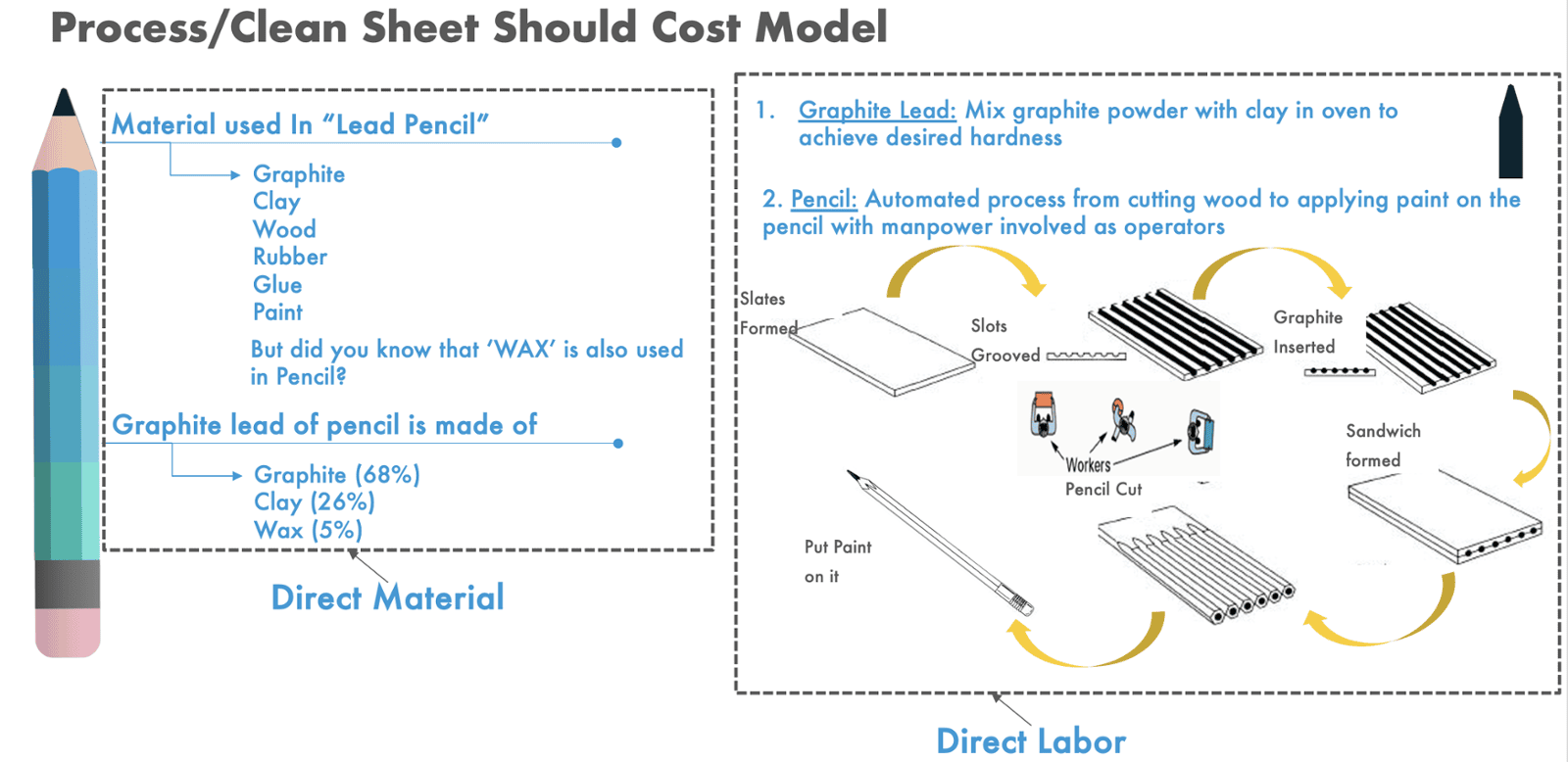
Clean sheet should cost model
Should cost model of a pencil
Case Study 1 - Spend Data Visualization
Case Study 2- Compressor Cost Breakdown
1. Deconstructing Volatility via Radical Transparency
A supplier’s bid is often a "black box," obscuring how much of the price is driven by actual input costs versus risk premiums. SCM utilizes a bottom-up approach, breaking down a product or service (e.g., an offshore rig, linear pipe, or drilling services) into its fundamental cost drivers: raw materials (steel, cement), energy, labor rates, equipment depreciation, and overheads.
In a volatile market, this transparency is crucial. If steel prices drop by 20%, SCM reveals exactly how that should impact the final cost of a pipeline project, preventing suppliers from maintaining artificially high prices when their own costs have decreased.
2. Enabling Dynamic, Index-Linked Pricing mechanisms
Fixed-price contracts in the O&G sector are often a gamble that one party will inevitably lose. SCM allows procurement teams to move away from rigid pricing and toward dynamic contracting models.
By identifying the primary cost drivers, SCM allows contracts to include precise indexation clauses. Instead of linking price escalation to a generic inflation index, the contract can link specific portions of the cost structure to relevant commodity indices (e.g., linking the materials portion of a rig rate to steel indices, or fuel costs to diesel benchmarks). This ensures that price adjustments reflect potential reality, protecting both the operator in a downcycle and the supplier in an upcycle.
3. Fact-Based Negotiation Leverage
In times of high volatility, negotiations often devolve into battles of perception regarding risk. SCM changes the dynamic from haggling to data-driven collaboration.
When an operator approaches a negotiation armed with a robust Should Cost Model, they are not arbitrarily demanding a discount. They are presenting a factual analysis of the supplier’s cost structure and reasonable margins. This forces the conversation away from opaque market sentiment and toward defensible cost components, making it difficult for suppliers to justify excessive premiums purely based on market uncertainty.
Conclusion
In the highly volatile Oil and Gas sector, uncertainty is inevitable, but overpaying for it is not. Should Cost Modelling transforms contracting from a reactive exercise in damage control into a proactive strategy for value preservation. By understanding the true DNA of cost, O&G companies can structure agreements that remain viable and fair through the inevitable peaks and troughs of the energy cycle.